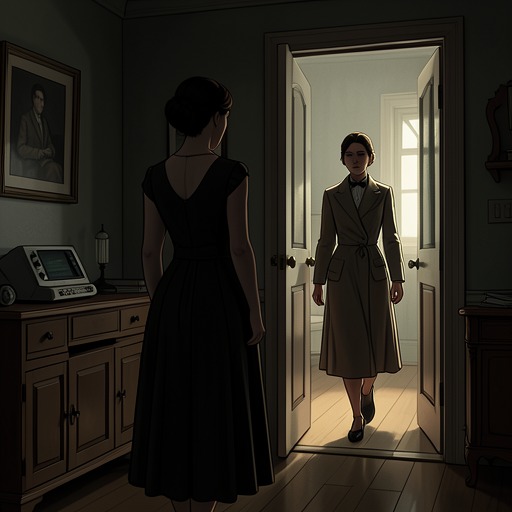
Angustias
The House of Bernarda AlbaAngustias is the eldest of Bernarda Alba’s five daughters, the only daughter of Bernarda’s first marriage, and the household’s richest woman. Her inheritance makes her the object of Pepe el Romano’s courtship and places her at the center of her sisters’ resentment, but money cannot resolve the emotional uncertainty of her engagement. She approaches marriage under restrictive social rules and ends the play amid the family’s insistence on concealing the truth about her younger sister Adela.
Identity and Family Position
At thirty-nine, Angustias is older than her four half-sisters and is set apart from them both by her parentage and by her financial position. Her stepfather, Antonio María Benavides, leaves her substantially more money than he leaves his natural daughters. The play’s commentary notes that Bernarda attacks Angustias for wearing make-up on the day of the funeral shortly after this unequal inheritance is revealed. The timing invites suspicion about what may be hidden within the household, but does not establish why Antonio María Benavides favored her or whether Bernarda suspects a particular explanation.
Angustias’s wealth grants her a kind of advantage in a family where marriage is closely linked to money and status. Amelia bluntly observes that Pepe is pursuing her because she alone is rich. That advantage does not make her warmly accepted: her sisters resent her inheritance and question why a desirable young man would court her. Their remarks about her appearance and manner of speaking sharpen the sense that she is being judged as much as envied.
Engagement and Household Rivalry
Angustias is to marry Pepe el Romano, a local man fourteen years younger than she is. The news provokes disbelief among her sisters, who consider him an attractive young man and contrast his choice of Angustias with what they imagine he might have wanted in Amelia or Adela. Their speculation turns the engagement into a household contest, intensifying existing bitterness over the inheritance and making Pepe’s attention a focus of attention even before the sisters know its full circumstances.
The engagement does not bring Angustias uncomplicated happiness. She is inexperienced and timid in matters of love, and admits that she ought to be happy but is not. Her uncertainty is reinforced by her perception of Pepe as distracted. When she tells Bernarda that she thinks he is hiding things from her, Bernarda does not encourage her to investigate. Instead, she instructs Angustias not to ask questions, not to let Pepe see her cry, and to speak only when he speaks. Marriage is presented not as a partnership between equals but as an arrangement in which Angustias must accommodate a husband’s conduct and silence her own doubts.
Surveillance, Secrecy, and Suspicion
The play repeatedly places Angustias’s courtship within the constrained geography of the house. Pepe visits her at the barred window, the traditional place for courtship, while the household listens for his movements. The sisters note that he left her window at half-past one; Poncia has also heard someone leaving at about four. These observations establish a climate of watchfulness around the engagement, though they do not by themselves resolve who was present or what happened after the visit.
Angustias later discovers that Pepe’s portrait, which had been under her pillow, is missing. She enters furiously and asks which sister took it; Martirio denies having it. The portrait’s disappearance brings the private rivalry surrounding Pepe into the open, but the scene initially leaves Angustias without an answer. Elsewhere, she says that when she looks at Pepe through the bars, his image blurs as if concealed by a cloud of dust raised by sheep. The image gives her suspicion a striking form: she can see him, yet cannot reach certainty about him or the future their marriage promises.
Marriage, Gender, and Reputation
Bernarda’s guidance to Angustias makes explicit the gender hierarchy that governs the household. When Angustias says Pepe seems distracted and reports his explanation that men have their problems, Bernarda tells her not to press him. Once married, she should speak when he speaks and look at him when he looks at her; if she follows this instruction, Bernarda claims, she will avoid disagreements. The advice treats a woman’s quiet compliance as the means of preserving domestic peace, rather than treating her concern as something her future husband should answer.
Angustias’s position also reflects the play’s wider social contrast between women’s restricted domestic lives and men’s comparative freedom. In the village culture the play depicts, women are expected to sew, embroider, and enter marriage under unequal conventions, while gossip and public judgment constrain their choices. Angustias’s inheritance gives her greater leverage in the marriage market, but it does not free her from the demands of obedience or from the family’s concern with appearances. Her engagement is thus both a personal prospect and a public matter through which money, gender, and reputation converge.
Ending and Dramatic Significance
When Martirio asks why Angustias’s fiancé has not come that night, Bernarda says he has gone away. The short exchange, accompanied by Martirio’s meaningful look toward Adela, places Angustias’s engagement within the secret relationships and rivalries that have been developing around her. The information does not give Angustias the full truth; instead, it underscores how much of the household’s emotional life is concealed from her.
After Adela’s death, Bernarda insists that Pepe escaped and orders the family to present Adela as having died a virgin. Angustias is among the daughters addressed as Bernarda forbids weeping and demands silence. The ending does not establish Angustias’s private response or tell what becomes of her engagement. It does show that she remains inside the same regime of family secrecy that has shaped her courtship: her inheritance could make her marriageable, but it cannot protect her from a household that values reputation and obedience over candor. Through Angustias, the play makes visible the difference between having economic advantage and possessing genuine freedom.